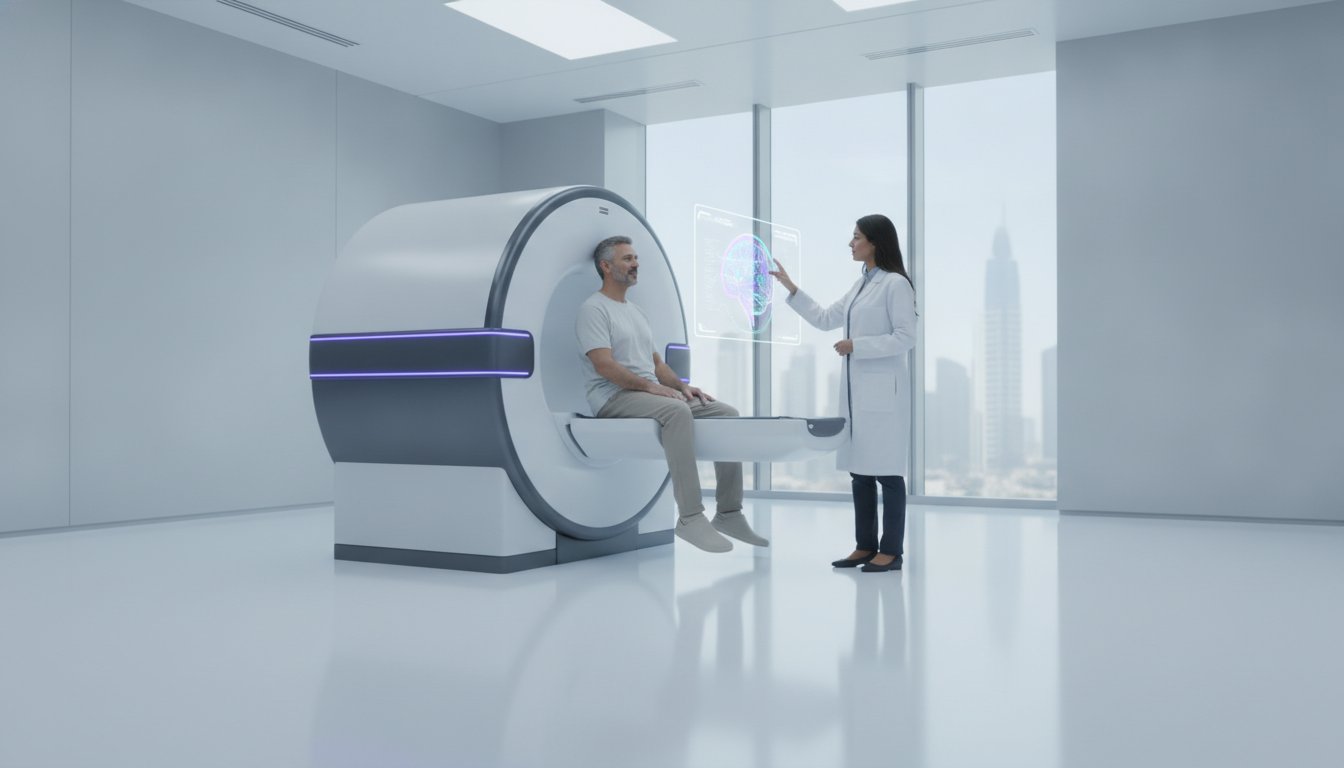
What if the most accurate diagnostic image didn’t require you to spend forty minutes inside a narrow, echoing tube? For many patients across the UAE, the mere thought of a traditional scanner triggers intense claustrophobia or physical distress. It’s a common struggle, especially for those dealing with chronic back pain that makes lying flat nearly impossible or those who simply can’t face the confinement of a closed-bore machine.
The good news is that medical imaging has undergone a significant transformation. You’ll discover how the advantages of open mri in 2026 have evolved through AI-powered clarity and specialized sitting technology to provide a stress-free environment that finally matches the precision of conventional systems. This modern approach ensures you don’t have to choose between your comfort and diagnostic excellence.
We’ll explore how these latest advancements utilize deep-learning algorithms to sharpen images while eliminating the need for sedation. From accommodating bariatric needs to providing clearer views of spinal issues through weight-bearing positions, you’re about to see why an open environment is now a clinically superior choice for your health journey.
Key Takeaways
- Identify the difference between wide-bore and truly open scanner architectures to find the most comfortable solution for claustrophobia.
- Discover how a patient-centric environment minimizes anxiety and significantly reduces the clinical need for medical sedation.
- Learn about the technical advantages of open mri when integrated with 2026 AI-powered reconstruction for high-resolution diagnostic clarity.
- Understand why sitting or weight-bearing scans can provide a more accurate diagnosis for spinal and joint conditions compared to lying flat.
- Access a professional checklist for choosing a specialized imaging facility in Dubai that offers advanced AI-enhanced hardware and software.
Understanding the Modern Open MRI: A Patient-Centric Design
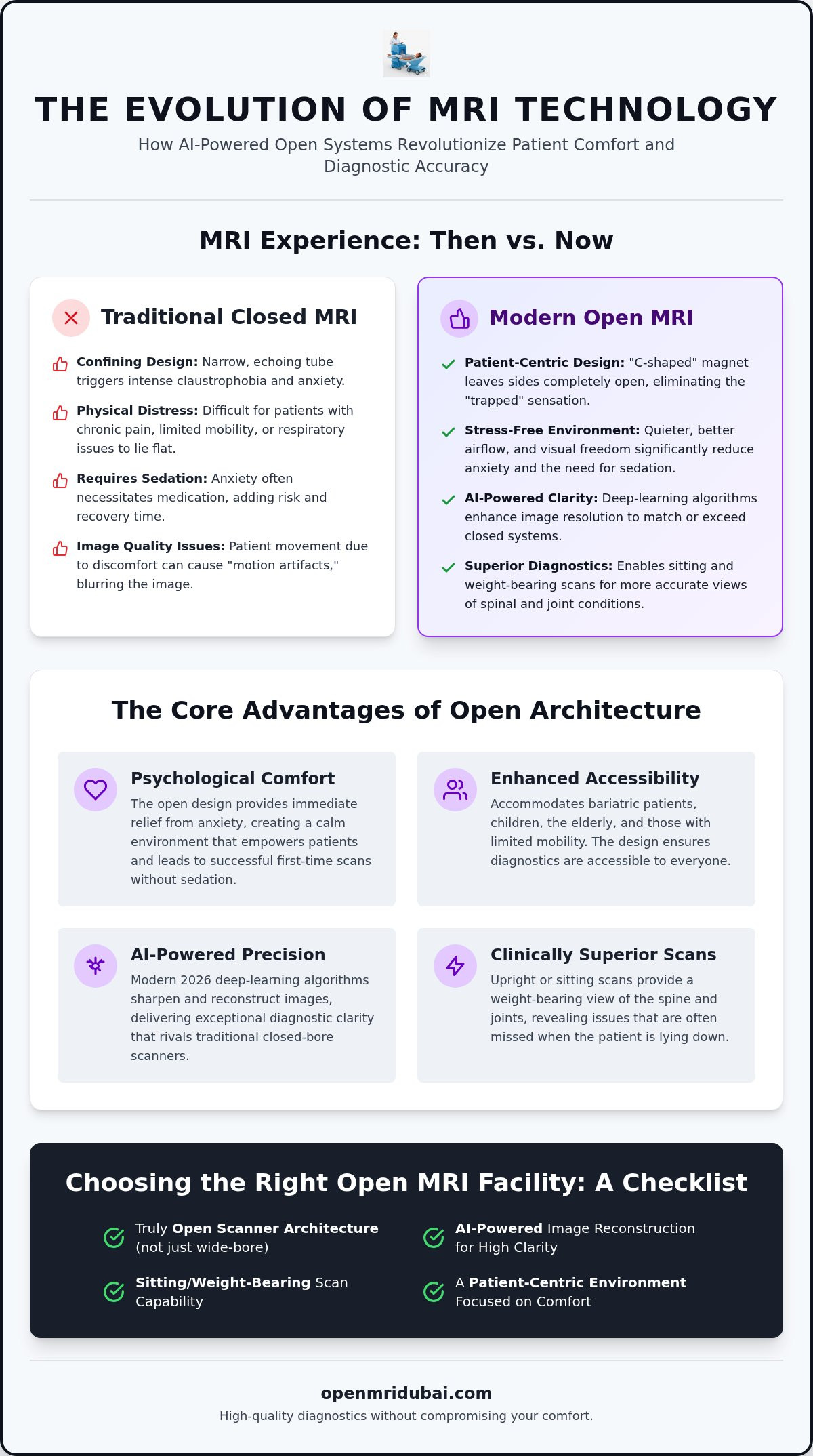
Traditional MRI scanners are often described as narrow, dark tunnels. This design, while historically standard, frequently creates a sense of confinement that can be overwhelming for many people. A modern Open MRI represents a complete departure from this architecture. Instead of a closed cylinder, an open scanner utilizes a “C-shaped” or “U-shaped” magnet design that leaves the sides completely open. This evolution from “open-bore” (which is simply a slightly wider tunnel) to “truly open” technology ensures that you’re never fully enclosed during your procedure.
One of the primary advantages of open mri is the shift toward a “Technological Caregiver” model. This approach prioritizes your mental well-being alongside clinical accuracy. By removing the physical barriers of a traditional machine, the environment feels less like a cold laboratory and more like a supportive medical suite. This physical openness is key to eliminating the “trapped” sensation that often leads to aborted scans or the need for medical sedation. For those seeking a comprehensive overview of MRI technology, understanding these structural differences is the first step in choosing a diagnostic path that fits your lifestyle.
The Architecture of Patient Comfort
The absence of a tunnel wall does more than just provide physical space. It significantly reduces the acoustic noise and vibration that often characterize traditional imaging. Since sound waves aren’t trapped in a small cylinder, the experience is much quieter and less jarring. You’ll also enjoy total visual freedom; you can maintain a direct line of sight with our technicians or even a family member throughout the procedure. Additionally, the open design allows for superior airflow and temperature control. This prevents the stuffy, overheated feeling common in enclosed bores, making it a preferred choice for patients in the warmer climate of the UAE.
Who Should Consider an Open Scan?
While anyone can benefit from a more relaxed environment, certain groups find these scans essential for a successful outcome. The advantages of open mri extend to several specific patient needs:
- Claustrophobia and Anxiety: If you’ve ever felt panicked in small spaces, the open sides provide immediate psychological relief and a sense of control.
- Bariatric Patients: Traditional 70cm bores can be physically restrictive. Open scanners offer the physical room necessary for a comfortable fit without the physical compression often felt in closed units.
- Limited Mobility: Patients who can’t lie perfectly flat due to acute spinal pain or respiratory issues can often be accommodated more easily, ensuring they don’t have to endure unnecessary discomfort to get an accurate diagnosis.
This patient-centric design ensures that high-quality diagnostics are accessible to everyone in Dubai, regardless of their physical or psychological requirements. By focusing on the person behind the patient ID, modern imaging facilities are transforming a stressful necessity into a manageable, comfortable experience.
The Psychological Advantage: Eliminating MRI Anxiety
Patient relaxation is a clinical requirement, not just a luxury. When a person feels anxious, their heart rate increases and they often struggle to remain perfectly still. Even minor movements can lead to “motion artifacts,” which are blurs on the final image that can obscure vital diagnostic details. One of the primary advantages of open mri is its ability to foster a sense of control and calm, which leads directly to successful first-time scans. By removing the physical barriers of a tunnel, we empower you to remain still through genuine comfort rather than through physical restraint or heavy sedation.
This psychological shift is supported by the FDA explanation of MRI, which highlights how the technology uses magnetic fields and radio waves to create detailed images of the body. In an open environment, these high-resolution results are achieved without the mental toll of confinement. Modern facilities in Dubai are increasingly adopting this “Technological Caregiver” approach, recognizing that a relaxed patient provides a much clearer window into their internal health. For many, the option of a sitting open MRI further normalizes the experience, making it feel less like a medical ordeal and more like a standard consultation.
Pediatric and Geriatric Excellence
The open design is transformative for our most vulnerable patients. For children, the experience can be terrifying; however, the open architecture allows a parent to hold their child’s hand or maintain eye contact throughout the entire procedure. This constant connection often eliminates the need for pediatric anesthesia. Similarly, elderly patients frequently struggle with kyphosis, a curvature of the spine that makes lying flat on a traditional table painful or impossible. The advantages of open mri include the flexibility to accommodate these physical needs, providing a non-threatening environment for those with tremors or cognitive impairments who might otherwise panic in a closed bore.
MRI Without Sedation: A Safer Alternative
In traditional imaging, sedation is often the only way to help a claustrophobic patient complete their scan. However, medical sedation carries inherent risks and requires significant recovery time. By choosing an open-format scanner, most patients find they can cooperate naturally with the technologist. This eliminates the costs associated with anesthesia and ensures you can drive yourself home immediately after your appointment. Since no sedative recovery is required, discharge times are significantly faster, allowing you to return to your daily routine in Jumeirah or elsewhere in the city without delay. If you’re concerned about how you’ll react to a scan, you can explore our patient-centric imaging options to see how we prioritize your comfort.
Diagnostic Accuracy: How AI Enhances Open MRI Clarity
For years, a persistent myth suggested that choosing an open scanner meant sacrificing image quality. In the past, lower magnetic field strengths often resulted in grainier images compared to traditional closed-bore machines. However, the 2026 technological landscape has completely dismantled this “quality gap.” One of the most significant advantages of open mri today is the integration of advanced artificial intelligence that works behind the scenes to ensure your results are as sharp as any conventional alternative.
AI-powered reconstruction algorithms now act as a sophisticated filter, identifying and removing “noise” from the raw data. These systems don’t just guess what an image should look like; they use deep-learning models trained on millions of high-resolution scans to reconstruct the anatomy with incredible precision. This computational power compensates for lower field strengths, delivering the high-contrast detail necessary for complex diagnoses. AI-powered imaging is the bridge between patient comfort and surgical-grade precision.
When reviewing patient information on MRI scans, you’ll find that accuracy is the most critical factor for any diagnosis. Modern open systems in Dubai now utilize these AI tools to provide a premium experience where you don’t have to compromise. By focusing on computational excellence, the advantages of open mri now include a level of diagnostic confidence that was previously only available in high-field closed units.
AI-Powered High-Resolution Results
Deep learning models have changed how we see internal tissues. These algorithms sharpen edges and enhance the contrast between different types of soft tissue, making it easier to spot inflammation or structural damage. Because the AI processes data so efficiently, scan sequences are also much faster. This reduces the time you spend on the table and minimizes the window for potential motion blur. Whether you’re a professional athlete or a busy executive in Jumeirah, these faster, sharper scans ensure that your diagnostic results are consistent, regardless of your body type or physical condition.
Smarter Imaging for Complex Diagnoses
Open scanners are no longer limited to simple joint checks. They’re now highly effective for detailed brain, spine, and musculoskeletal health assessments. AI assists radiologists by highlighting subtle abnormalities that might be missed by the human eye alone. When comparing AI-enhanced open results to traditional 1.5T closed scans, the clinical outcomes are often indistinguishable. This means you can enjoy the spaciousness of an open environment while receiving the same level of diagnostic detail required for intricate surgical planning or long-term wellness monitoring.
Clinical Superiority: The Benefits of Sitting and Upright Scans
Gravity changes how your body functions. While traditional recumbent scans require you to lie flat on your back, many people find that their symptoms only surface when they are sitting or standing. One of the most significant clinical advantages of open mri is the ability to perform weight-bearing imaging. This specialized approach captures the true state of your spine and joints under the natural force of gravity, providing a much more accurate representation of your daily physical reality.
In a recumbent position, the pressure on your spinal discs and joints is naturally relieved. This can lead to “false negatives,” where a scan appears normal even though the patient is in significant pain during their daily routine. By utilizing a sitting open MRI, clinicians can observe how your anatomy responds to the weight of your own body. This functional perspective is often the key to identifying the root cause of chronic issues that remain hidden in conventional, tunnel-based machines.
Dynamic Spine and Joint Assessment
Weight-bearing scans are particularly transformative for spinal health. Certain disc herniations or slippages actually “disappear” when you lie flat, as the vertebrae are no longer compressed. A sitting scan allows the radiologist to see these issues in a functional position. This technology is also vital for evaluating pelvic floor instability and joint misalignments that only occur when the body is upright. Capturing this “positional” pain ensures that your treatment plan is based on how your body actually moves and reacts throughout the day in Dubai.
Improved Patient Positioning for Targeted Scans
The open architecture of these scanners allows for much greater flexibility in how a patient is positioned. Unlike a narrow tube that limits movement, an open environment enables the technologist to flex or extend a joint during the scan for better visualization. This is especially helpful for imaging specific extremities, such as elbows or knees, without requiring you to hold awkward or painful contortions. Additionally, sitting technology is a life-changing solution for patients with severe respiratory issues or heart conditions who find it physically impossible to lie flat for any length of time. If you struggle with positional pain, you can book a sitting open MRI in Dubai to get a more accurate diagnosis today.
This level of clinical superiority ensures that the diagnostic process is as precise as it is comfortable. By matching the technology to the patient’s natural posture, modern imaging centers are providing a higher standard of care that traditional closed systems simply cannot replicate.
Choosing the Right Open MRI Facility: A Patient Checklist
Selecting the right diagnostic center in Dubai involves more than just finding the nearest location. To truly benefit from the advantages of open mri, you must ensure the facility integrates high-end technology with specialized clinical expertise. An open scanner is a sophisticated tool, and its effectiveness depends heavily on the software powering it and the professionals interpreting the data. When you’re researching options, prioritize centers that treat imaging as a personalized experience rather than a routine procedure.
A premium facility should offer a comprehensive diagnostic environment. This means they don’t just provide MRI services but also maintain a full suite of complementary tools, such as digital X-rays and CT scans. Having these resources in one place allows for a more holistic approach to your health, especially if your consultant requires multiple types of imaging to confirm a complex diagnosis. Additionally, always verify the credentials of the reporting radiologists. You want a team that’s specifically trained to interpret AI-enhanced results and weight-bearing positional scans, as these require a nuanced understanding of functional anatomy.
Evaluating Technology and Expertise
Not all open scanners are created equal. To ensure you receive surgical-grade clarity, use this checklist during your initial inquiry:
- AI Integration: Ask if the center utilizes AI-powered reconstruction software for their open scans. This technology is what bridges the quality gap between open and closed systems.
- Positional Capabilities: If you’re dealing with back or joint pain, check if they offer specialized sitting or upright capabilities. As we’ve discussed, these are vital for capturing “hidden” issues.
- Turnaround Times: Inquire about how quickly you’ll receive your high-resolution diagnostic report. Leading facilities in Jumeirah typically provide detailed results within 24 to 48 hours.
Preparing for Your Open MRI Experience
Your preparation for an open scan is straightforward, but a few small steps can make the day even smoother. Wear loose, comfortable clothing and avoid items with metal zippers, underwires, or jewelry, as these can interfere with the magnetic field. When you arrive, the check-in process will involve a safety screening to ensure you don’t have any incompatible medical implants. This is also the perfect time to communicate your comfort needs to the imaging team. Whether you need a specific cushion for support or want to maintain eye contact with a family member, don’t hesitate to speak up.
The goal is to make your diagnostic journey as seamless and stress-free as possible. By choosing a facility that views itself as a “Technological Caregiver,” you ensure that your physical comfort and diagnostic accuracy are never at odds. If you’re ready to experience a more supportive way to manage your health, you can Book your AI-powered Open MRI scan today and take the first step toward a clearer diagnosis.
Embrace a New Standard of Diagnostic Care
The evolution of medical imaging means you don’t have to sacrifice peace of mind for clinical accuracy. By integrating AI-powered high-resolution imaging with specialized sitting and upright technology, we’ve transformed the diagnostic experience into one that is both precise and genuinely supportive. These advantages of open mri ensure that every patient, from those facing claustrophobia to those with complex spinal conditions, receives a clear and actionable path forward. You no longer need to fear the confinement of a traditional scanner to get the answers you need.
Our expert radiologists specialize in non-claustrophobic diagnostics. They use modern computational tools to deliver results that were once only possible in restrictive, closed environments. You deserve a healthcare journey that respects your physical comfort while providing the surgical-grade clarity your diagnosis requires. This patient-centric approach eliminates the need for medical sedation and ensures you can return to your daily life in Dubai immediately after your appointment without any recovery time.
Schedule Your Comfortable, AI-Powered Open MRI Scan Today
Your health is too important to wait for a solution that causes you distress. We’re here to guide you through a stress-free imaging experience that puts your well-being at the center of every scan. Let’s find the answers together in a space where you feel safe and supported.
Frequently Asked Questions
Is an open MRI scan as accurate as a closed tunnel MRI?
Modern open scanners deliver high-resolution results that rival traditional closed-bore systems. In 2026, AI-powered reconstruction algorithms identify and remove image noise, ensuring that diagnostic precision remains exceptionally high. This advanced technology allows radiologists to see fine anatomical details with surgical-grade clarity. You no longer have to sacrifice the quality of your diagnosis to ensure your personal comfort during the procedure.
Can I get an open MRI if I have a high BMI or am overweight?
Open-format scanners are an ideal solution for patients who require more physical space than a standard 70cm bore provides. The open architecture eliminates the physical compression and “tight fit” often experienced in traditional machines. This design ensures a dignified and comfortable experience for bariatric patients in Dubai, allowing for high-quality imaging without the physical restrictions of a narrow tunnel.
How long does an open MRI scan usually take with AI technology?
Most examinations are completed within 15 to 45 minutes, depending on the specific area being scanned. AI-powered imaging significantly accelerates the data acquisition process, which means you spend less time on the table than you would with older technology. This increased efficiency also reduces the window for potential motion blur, leading to faster results and a more streamlined appointment in Jumeirah.
Do I need a doctor’s referral for an open MRI scan?
You typically require a referral from a licensed physician to ensure the scan is targeted to your specific medical needs. A formal referral is also a standard requirement for processing insurance claims within the UAE healthcare system. If you don’t have a referral yet, many facilities can help guide you toward a specialist who can evaluate your symptoms and provide the necessary documentation.
Will an open MRI help if I am extremely claustrophobic?
One of the primary advantages of open mri is the immediate psychological relief it offers to those with claustrophobia. Since the scanner features open sides, you maintain a constant line of sight with the room and the technologist. This sense of freedom and control often eliminates the need for medical sedation, making it possible to complete the scan calmly and successfully.
What is the difference between a sitting MRI and a standing MRI?
A sitting MRI utilizes a specialized chair-like structure, while a standing MRI requires you to remain completely upright. Both are types of weight-bearing imaging that allow doctors to see how your spine and joints react to gravity. Sitting scans are often more accessible for patients in Dubai who suffer from acute pain and find it difficult to stand still for extended periods.
Can children use an open MRI without being sedated?
Children are much more likely to complete their scans without sedation in an open environment. The open design allows a parent to sit close enough to hold their child’s hand or maintain eye contact throughout the entire process. This “Technological Caregiver” approach provides the natural reassurance children need to stay still, avoiding the risks and recovery times associated with pediatric anesthesia.
Are open MRI scans covered by standard health insurance?
Most major health insurance providers in the UAE cover these procedures when they are deemed medically necessary by a physician. The advantages of open mri are well-recognized by insurers for patients with specific needs, such as claustrophobia or physical disabilities. It’s always best to check your specific policy or ask the facility to assist with the pre-authorization process before your visit.