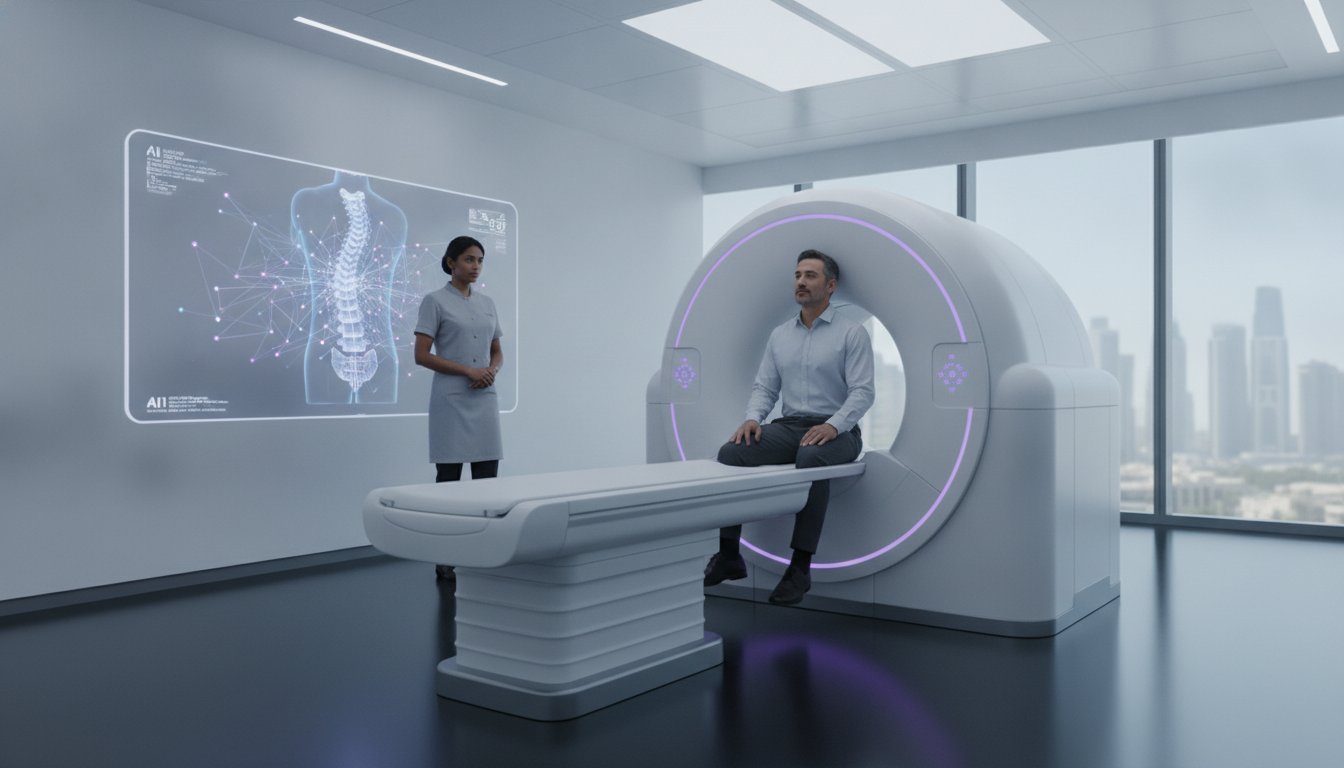
What if the most comfortable choice for your next diagnostic scan was also the most precise one for identifying the source of your pain? Many patients across the UAE feel a genuine sense of dread when faced with a traditional, narrow tube; leading to the common question: is open MRI as accurate as closed MRI? It’s completely natural to worry that opting for a more spacious environment might result in lower resolution images or the need for a frustrating repeat scan. You’ve likely heard confusing jargon regarding field strength and wondered if a “weaker” magnet means a less reliable diagnosis.
We understand these concerns and want to provide the clinical clarity you deserve. This article reveals how modern AI-powered technology and positional scanning have effectively bridged the gap between open and closed MRI diagnostics. You’ll learn why image quality is now about advanced computational integration rather than just magnet size; and we’ll explore specific cases where an open system is actually the superior tool for your health. By the end, you’ll have the confidence to choose a scan that prioritizes both your physical comfort and your doctor’s need for precision.
Key Takeaways
- Find out why the common concern of is open MRI as accurate as closed MRI has been resolved through AI-powered enhancements and high-resolution imaging.
- Discover why sitting open MRI is often the superior diagnostic tool for back and neck pain, as it captures the spine under natural weight-bearing stress.
- Understand how modern software integration allows you to prioritize a non-claustrophobic environment without sacrificing diagnostic precision.
- Identify specific medical conditions where positional scanning provides a more precise clinical picture than lying flat in a traditional machine.
- Gain a clear framework for discussing your imaging options with your physician to ensure you book the most effective scan for your needs in Dubai.
The Evolution of MRI: Understanding the Accuracy Debate
Magnetic Resonance Imaging (MRI) is a sophisticated, non-invasive diagnostic tool that uses powerful magnetic fields and radio waves to create detailed images of your body’s internal structures. For years, patients and clinicians in Dubai have debated a central question: is open MRI as accurate as closed MRI? Historically, the answer was nuanced because the physical shape of the machine directly influenced the strength and stability of the magnetic field. However, the diagnostic landscape has shifted significantly. Modern open systems are now engineered for clinical equivalence, proving that accuracy is no longer determined solely by whether a machine is a narrow tube or an open, airy space.
Accuracy in medical imaging is a multifaceted concept. It isn’t just about the “strength” of a magnet; it’s about the clarity of the final image and the ability of a physician to make a confident diagnosis. We’ve moved beyond the era where patient comfort was a trade-off for quality. Today, high-resolution results are achievable in environments that prioritize your well-being, especially if you struggle with anxiety or physical limitations that make traditional machines difficult to use.
What Defines MRI Accuracy?
High-quality diagnostics rely on several technical factors that go beyond the machine’s appearance. The signal-to-noise ratio (SNR) is perhaps the most critical. It represents the balance between the “signal” captured from your body’s tissues and the background electronic “noise.” A higher SNR results in a clearer, crisper image that allows for better visualization of small structures. Spatial resolution also plays a vital role, as it determines the system’s ability to distinguish between two tiny, adjacent points. Finally, the expertise of the radiologist interpreting the data is paramount. Even the highest-resolution scan requires a skilled professional to identify subtle pathologies that might indicate an underlying health issue.
The Traditional View: Why Closed Was Considered Superior
The belief that closed systems were inherently better stems from the physics of cylindrical magnets. These “closed-bore” machines typically offer higher Tesla (T) ratings, which measure magnetic field strength. In the past, older open magnets often struggled with “fringe” interference. This occurred because the magnetic field wasn’t as tightly contained as it is in a tube, sometimes leading to grainier images. While these historical limitations were real, they no longer apply to advanced diagnostic centers in the UAE. Today’s high-field open magnets, combined with sophisticated shielding and computational power, have effectively eliminated these old interference issues. You don’t have to choose between a clear diagnosis and a comfortable experience anymore.
How AI and Field Strength Work Together for High-Resolution Results
In the past, image quality was limited by the physical strength of the magnet. If you wanted high-resolution results, you generally had to enter a high-Tesla closed machine. Today, that’s no longer the case. The integration of artificial intelligence has revolutionized how we process diagnostic data. It allows us to answer the question, is open MRI as accurate as closed MRI, with a resounding yes for the vast majority of clinical applications. By shifting the focus from raw hardware power to sophisticated software reconstruction, we’ve unlocked a new era of patient-centric diagnostics.
One major hurdle for older open machines was “artifacts,” or blurring caused by slight patient movements or lower signal levels. Modern AI-powered diagnostic imaging acts as a digital lens, filtering out this background noise and reconstructing raw data into sharp, high-definition visuals. This is especially vital for complex neurological cases where every millimeter of tissue detail counts. When every pixel is optimized by advanced algorithms, the diagnostic clarity matches or exceeds what was once only possible in a confined, cylindrical tube.
The Role of AI in Modern Diagnostics
Modern AI algorithms don’t just “clean up” an image; they actively fill in data gaps to create sharper edges and clearer contrast. This noise reduction technology allows for faster scans because the system can interpret signals more efficiently. For patients in Dubai, this means less time spent in the machine and a more reliable result for the radiologist. By highlighting subtle abnormalities that might have been missed by older, hardware-only systems, AI ensures that your diagnostic journey is both comfortable and precise. It’s a supportive approach that uses innovation to remove the traditional trade-off between comfort and quality.
Field Strength vs. Image Quality
There’s a common medical myth that “more Tesla always equals a better diagnosis.” While a 3.0T machine has its place in specific research or ultra-fine vascular studies, a 0.5T or 1.2T open MRI equipped with advanced software can easily rival the output of a standard 1.5T closed machine. AI algorithms intelligently compensate for lower field strengths by reconstructing high-definition visuals from complex signal data. This synergy between hardware and software is what defines the modern AI-powered diagnostic imaging experience. It ensures that you receive the highest standard of care without the anxiety of a confined space, proving that the smartest technology is the one that puts the patient first.
When Open MRI Is More Accurate: The Power of Positional Scanning
While we’ve established that AI closes the gap in image resolution, there are specific clinical scenarios where the open design provides a distinct diagnostic edge. When patients ask, is open MRI as accurate as closed MRI, they are often surprised to learn that for spinal and joint issues, the open format can actually be superior. This is due to the capability of performing a sitting open mri dubai, which allows the body to be imaged in its natural, symptomatic state. For many, pain isn’t something that happens while lying down; it’s something that occurs during the daily activities of sitting, standing, or bending.
Standard closed machines require you to lie perfectly flat. While this is fine for many internal organ scans, it’s often counterproductive for diagnosing chronic back or neck pain. Many pathologies only manifest when the body is under the stress of gravity. By utilizing positional scanning, we can capture the true state of your anatomy while you are sitting or standing. This provides a more precise clinical picture than a supine scan ever could, ensuring that your treatment plan is based on how your body actually functions in the real world.
The Weight-Bearing Advantage
Gravity is a powerful diagnostic variable. When you lie down, the pressure on your spinal discs is relieved, which can cause a herniation to temporarily recede. This often leads to “false negative” results where a scan looks normal despite the patient being in significant pain. An upright scan captures the spine under the weight of the head and torso. This weight-bearing perspective is essential for identifying the true extent of disc bulges or spinal misalignments. Athletes in the UAE frequently seek out this technology because it allows for joint imaging in functional positions, revealing instabilities that stay hidden when the limb is at rest.
Reducing Motion Artifacts Through Comfort
The most common cause of a failed or blurry MRI isn’t the machine’s age; it’s patient movement. In a traditional, enclosed tube, even a minor bout of claustrophobia can lead to involuntary twitching or heavy breathing. These micro-movements create “motion artifacts” that degrade image quality. Because an open environment significantly reduces anxiety, patients find it much easier to remain still for the duration of the procedure. A relaxed patient in a sitting open mri dubai environment produces cleaner, more reliable data. This psychological link between physical comfort and diagnostic success is a cornerstone of modern, patient-centric care.
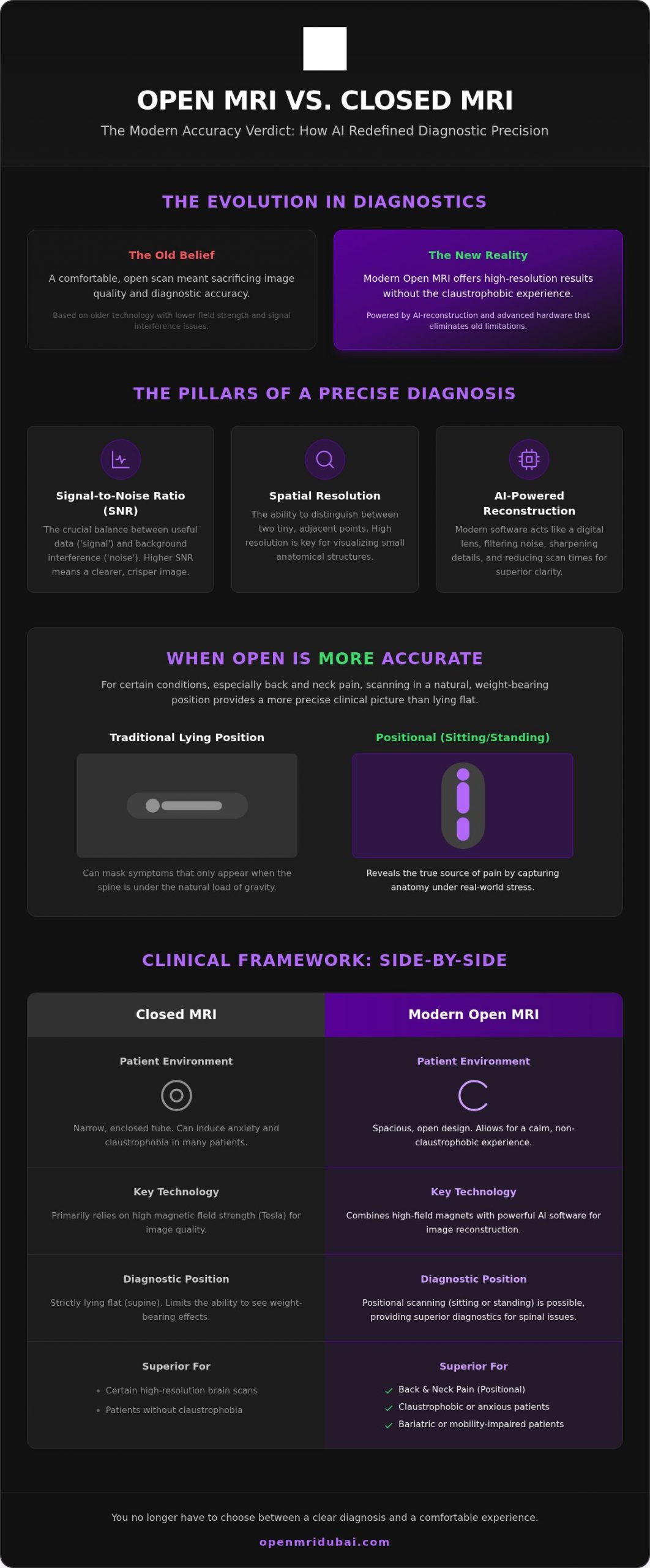
Comparing Open vs. Closed MRI: A Clinical Framework
Choosing between imaging methods shouldn’t be a source of stress or confusion. For approximately 95% of routine clinical diagnostics, both systems provide equivalent results that allow physicians to create effective treatment plans. If you’ve been wondering: is open MRI as accurate as closed MRI? The answer is yes for the vast majority of standard orthopedic, neurological, and abdominal scans. The decision often comes down to a balance of your personal comfort and the specific clinical questions your doctor needs to answer.
While closed units sometimes offer slightly faster scan times due to higher raw field strength, open units provide specialized benefits that a traditional tube simply cannot match. It’s a trade-off between the pure speed of a high-Tesla machine and the specialized positioning and physical ease of an open environment. For most patients in Dubai, the reduction in anxiety and the ability to be scanned in a natural position far outweigh the few extra minutes spent in the machine.
Best Uses for Open MRI Technology
Open systems excel in specific scenarios where traditional machines struggle to provide a complete picture or a comfortable experience. We highly recommend this technology for several key groups:
- Chronic Back and Neck Pain: Utilizing a sitting open mri dubai allows for weight-bearing images that reveal disc issues hidden during lying-down scans.
- Pediatric Imaging: Children often feel frightened in enclosed spaces. The open design allows a parent to stay close and even hold their child’s hand, often removing the need for sedation.
- Bariatric Patients: Traditional bores have strict weight and size limits. Open machines provide the necessary space for patients of all body types to be scanned with dignity and comfort.
- Severe Claustrophobia: For those who experience intense anxiety in confined spaces, the open environment ensures the scan is completed successfully without the need for repeat appointments.
Questions to Ask Your Radiologist
Before you book your appointment, it’s helpful to have a direct conversation with the imaging facility. This ensures you’re receiving the highest standard of care available in the UAE. Consider asking the following questions:
- “Does this facility utilize AI-powered diagnostic imaging to enhance the resolution of my open scan?”
- “Can I be scanned in a sitting or standing position to better evaluate my specific pain symptoms?”
- “What is the expected resolution for this specific body part, and will it meet my referring doctor’s requirements?”
If you’re looking for a diagnostic experience that prioritizes both your comfort and clinical precision, you can book an open MRI scan at our Jumeirah facility to get started on your path to recovery.
Choosing Advanced Imaging in the UAE: The Open MRI Dubai Standard
Open MRI Dubai stands as a premier destination for AI-Powered Diagnostic Imaging in the United Arab Emirates. We’ve carefully designed our services to ensure that the question of whether an is open MRI as accurate as closed MRI is answered through innovation rather than compromise. By adhering to the latest Dubai Health Authority standards for diagnostic imaging, which were updated to ensure peak patient safety in late 2025, we provide a level of care that prioritizes both precision and comfort. You don’t have to choose between a supportive environment and the high-resolution results your physician requires for an effective treatment plan.
We believe that modern healthcare should be as stress-free as possible. Our facility isn’t just about the machines; it’s about a philosophy of care that puts your well-being at the center of every scan. By combining the latest technological advancements with a premium, patient-centric environment, we’ve set a new standard for diagnostics in Jumeirah. This approach ensures that every individual who walks through our doors feels heard, supported, and confident in the accuracy of their results.
The AI-Powered Difference
Our facility integrates sophisticated AI algorithms that act as a bridge between patient comfort and clinical excellence. These tools allow our team to reconstruct raw signal data into sharp, high-definition visuals that rival traditional closed systems. This focus on diagnostic integrity ensures that every patient, regardless of their condition, receives a scan that is both precise and reliable. We believe that a premium experience should include the peace of mind that comes from knowing your data is being processed by some of the most advanced technology in the region. Our team acts as a technological caregiver, guiding you through the process with a focus on your physical and emotional comfort.
Booking Your Comfortable Scan
Moving from a referral to a completed scan is straightforward and stress-free. When you arrive for your sitting open mri dubai session in Jumeirah, you’ll find an environment that feels more like a modern suite than a cold, traditional clinic. Our technicians are trained to provide empathetic support, ensuring you feel well-informed throughout the procedural journey. Whether you’re seeking a scan for a complex spinal pathology or a routine orthopedic check, our open-bore and sitting units offer the space you need to remain calm. This methodical approach ensures that we capture the highest quality data while you remain in a natural, relaxed position.
Experience high-resolution, non-claustrophobic imaging at Open MRI Dubai.
A Clear Path to Diagnostic Clarity and Comfort
The evolution of medical imaging has reached a point where you no longer have to sacrifice peace of mind for clinical precision. We’ve explored how AI-powered technology and specialized sitting MRI systems have fundamentally changed the answer to the question: is open MRI as accurate as closed MRI? By combining advanced software with positional scanning, modern open systems provide the high-resolution data your doctor needs while keeping you in a relaxed, non-claustrophobic environment. This synergy ensures that weight-bearing issues are captured with absolute clarity. These vital details are often hidden in traditional, lying-flat machines.
Our facility in Jumeirah is dedicated to this standard of excellence. With expert radiologists specializing in open-format diagnostics and a focus on patient-centric care, we ensure your diagnostic journey is as seamless as it is accurate. You deserve a healthcare experience that respects your physical comfort without compromising on the quality of your results. Take the next step toward understanding your health in a space designed for your well-being. Book your high-resolution Open MRI scan today and discover how our specialized technology provides the answers you need with the comfort you deserve.
Frequently Asked Questions
Is the image quality of an open MRI good enough for a spine surgery referral?
Yes, the image quality provided by our advanced open systems is more than sufficient for spine surgery referrals. Surgeons in Dubai frequently request these scans because they can evaluate the spinal column under natural, weight-bearing conditions. This provides a more precise assessment of disc herniations or spinal stenosis that might temporarily recede when a patient is lying flat in a traditional machine, ensuring a more accurate surgical plan.
How does AI help in making an open MRI more accurate?
AI technology enhances accuracy by processing raw data to reduce background noise and sharpen image edges. These advanced algorithms help bridge the gap when patients ask if an is open MRI as accurate as closed MRI by reconstructing high-definition visuals from complex signals. The software compensates for lower hardware field strengths, ensuring that the final diagnostic report is clear and reliable for your referring physician.
Can I get a sitting MRI if I have severe claustrophobia?
A sitting MRI is an ideal solution for patients with severe claustrophobia. Unlike traditional machines that require you to enter a narrow, enclosed tube, our open design allows you to remain in a comfortable seated position with a clear view of your surroundings. This significantly reduces anxiety and the feeling of confinement, which often eliminates the need for sedation or the risk of repeat appointments due to patient movement.
Do doctors in the UAE accept results from an open MRI scan?
Doctors across the UAE widely accept and trust results from high-quality open MRI scans. Our facility adheres to the strict diagnostic imaging standards set by the Dubai Health Authority (DHA), which were updated in late 2025 to ensure peak patient safety. Whether you are seeing a specialist in Jumeirah or a surgeon at a major hospital, these reports provide the authoritative data needed for your healthcare journey.
What is the difference in Tesla strength between open and closed MRI?
Traditional closed machines typically operate at field strengths of 1.5T to 3.0T, while modern open systems generally range from 0.5T to 1.2T. A common question is whether an is open MRI as accurate as closed MRI despite this difference. The integration of AI-powered imaging allows modern open units to achieve diagnostic results that rival their higher-Tesla counterparts, ensuring clinical precision even if the raw magnetic field strength is lower.
Is an open MRI as fast as a traditional closed MRI scan?
Modern open MRI scans are comparable in speed to traditional sessions, typically lasting between 15 and 60 minutes depending on the area being examined. While some high-field closed machines might offer slightly shorter scan times for specific sequences, the difference is usually negligible for the patient. The added comfort of an open environment often makes the time feel like it passes much faster than in a confined tube.
Are there any body parts that cannot be scanned with an open MRI?
Most body parts, including the spine, joints, brain, and abdomen, can be effectively scanned using an open MRI system. There are very few clinical exceptions where a high-field closed bore is mandatory, such as certain ultra-fine vascular studies or specific research-level cardiac imaging. For the vast majority of orthopedic and neurological diagnostic needs in Dubai, an open system is a perfectly valid and highly accurate choice.
Does a sitting MRI show things a lying-down MRI might miss?
Yes, a sitting MRI can reveal pathologies that a standard lying-down scan might miss. When you lie flat, gravity is removed from your spine and joints, which can cause disc bulges to recede or joint instabilities to disappear. Capturing images while you are in a seated, weight-bearing position provides a more realistic view of how your anatomy reacts to the daily stress and pain triggers you experience.
Leave a Reply